What It Is
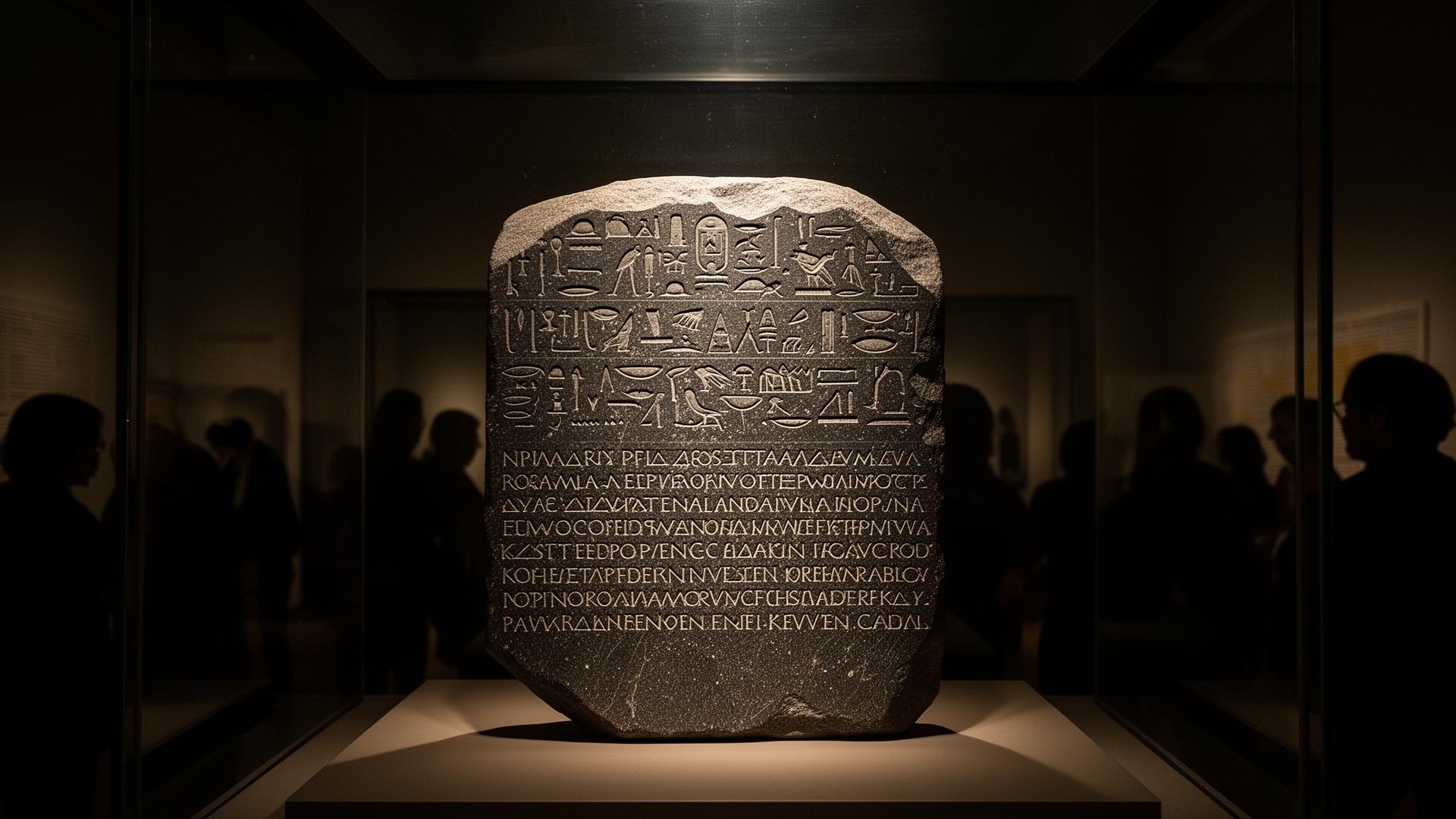
The Rosetta Stone is not a jewel, a prophecy, or a royal portrait. It is a bureaucratic decree — one of thousands churned out by the priestly administration of Ptolemaic Egypt — that happened to survive the millennia because it was carved into dense, dark granodiorite rather than the more common and fragile papyrus. What makes this particular slab extraordinary is not the content of its message but the form of its delivery: the same text inscribed in three distinct scripts.
At the top, fourteen lines of hieroglyphs — the sacred script of Egyptian temples, reserved for priests and the eternal speech of kings. In the middle, thirty-two lines of Demotic — the cursive, everyday script of commerce, law, and common record. At the bottom, fifty-four lines of Ancient Greek — the lingua franca of the Mediterranean world after Alexander's conquest, the language of Egypt's new Greek-speaking rulers.
The text itself is a routine priestly decree issued in 196 BC during the reign of Ptolemy V Epiphanes. It confirms the divine cult of the king, grants tax exemptions to temples, and instructs that the decree be displayed in every temple of Egypt. Nothing in the content hints at the stone's future fame. Its power lies entirely in its trilingual design — a built-in Rosetta Stone in the most literal sense.
Discovery
In July of 1799, Napoleon Bonaparte's soldiers were fortifying the port of Rashid — known to Europeans as Rosetta — on Egypt's Mediterranean coast. Lieutenant Pierre-François Bouchard, supervising demolition work on an old Mamluk fortification, noticed something unusual in the foundation stones: a slab of dark rock covered in dense, regular carvings. Recognizing its potential importance, Bouchard reported the find to his superiors. General Jacques-François Menou, who fancied himself a man of culture, promptly claimed it for his personal collection.
The stone's military career was short-lived. In 1801, after Nelson's victory at the Nile and the subsequent French surrender, the Treaty of Alexandria stipulated that all antiquities discovered by the French expedition be handed over to the British. General Menou protested that the stone was his private property, wrapped it in a flag, and shipped it toward Alexandria under cover of night. The British intercepted it anyway. In February 1802, the Rosetta Stone arrived at the British Museum, where it has remained ever since — a prize of war that became a monument to human curiosity.
Copies of the inscriptions circulated across Europe immediately. The challenge was clear: if scholars could match the Greek text — which was perfectly legible — against the unknown Egyptian scripts, they could unlock a language that had been dead for over a thousand years. The race was on.
The Race to Read
For two decades, the best minds in Europe struggled with the stone's riddles. The English polymath Thomas Young made the first crucial breakthrough in 1814, demonstrating that certain hieroglyphic signs were not purely symbolic but represented sounds — specifically, that oval loops called cartouches contained royal names. Young correctly identified the cartouche of Ptolemy, but he never accepted that the entire script was phonetic. He remained convinced that hieroglyphs were fundamentally symbolic, with sound values grafted on as secondary features.
The full solution fell to a young Frenchman named Jean-François Champollion. Working from copies in Paris, Champollion applied a rigorous comparative method, cross-referencing the Rosetta Stone with other bilingual inscriptions and drawing on his extraordinary gift for languages — he had taught himself Hebrew, Syriac, Arabic, Persian, and Coptic as a teenager. On September 14, 1822, at the age of thirty-two, Champollion collapsed the barrier. He realized that hieroglyphs were a mixed system: some signs represented sounds, others represented whole words, and still others served as semantic determinatives. The script was not a primitive picture-language but a sophisticated writing system every bit as flexible as Greek or Latin.
Legend has it that Champollion ran through the streets of Paris shouting "Je tiens l'affaire!" ("I've got it!"), then collapsed from exhaustion and spent the next five days in bed. Whether or not the dramatic sprint happened, the exhaustion was real. He had spent his entire adult life in pursuit of this single problem. Two years later, in 1824, he published his Précis du système hiéroglyphique, and the doors of Pharaonic Egypt swung open for the first time since the last temple closed.
Significance to Civilization
Before Champollion, ancient Egypt was a land of mute monuments. The pyramids, the temples, the painted tombs — all of them spoke a language no one living could understand. Egyptologists could measure and classify, but they could not read. The Rosetta Stone changed that forever. Within a generation, scholars were translating temple inscriptions, papyrus rolls, and funerary texts with confidence. Three thousand years of history, theology, poetry, and administrative record became accessible to the modern world.
The implications rippled far beyond Egyptology. The decipherment proved that non-alphabetic writing systems could be cracked through systematic comparison — a methodology that would later be applied to cuneiform scripts, Linear B, and even Mayan glyphs. It demonstrated that ancient civilizations had possessed intellectual complexity equal to anything in the classical world. And it opened a window into religious thought far older than the Hebrew Bible: Egyptian concepts of judgment after death, divine resurrection, and the moral weighing of the soul found their first modern audience through the medium of hieroglyphic translation.
For Egypt itself, the Rosetta Stone became a symbol of recovered identity. Under foreign rule for two millennia — Persian, Greek, Roman, Arab, Ottoman, British — modern Egyptians found in the deciphered language of the pharaohs a connection to a past that colonizers had dismissed as primitive superstition. When the stone was displayed in the British Museum's Egyptian Sculpture Gallery, it drew millions of visitors from across the globe, each of them standing before a text that had waited fourteen centuries to be read.
Today, the Rosetta Stone remains the British Museum's most visited object. It has lent its name to software, space missions, and language-learning platforms. But its true legacy is quieter: the simple, revolutionary proof that no civilization is ever truly lost, so long as someone stubborn enough — a Bouchard, a Young, a Champollion — persists in the attempt to listen.
"The Egyptian writing is a complex system, a script simultaneously figurative, symbolic, and phonetic..."
Next week: the Lachish Reliefs — Sennacherib's carved boast of a Judean siege, told from the Assyrian side of the wall.
Back to Field Trip →